




Healthcare organizations today operate under intense financial pressure. Rising operational costs, complex insurance rules, and delayed reimbursements make efficient revenue management essential. At the heart of this system lies medical billing, which plays a direct and measurable role in Medical Billing Revenue Cycle Performance.
From patient registration to final payment collection, billing accuracy determines whether healthcare providers maintain healthy cash flow or struggle with denials and revenue leakage. This blog explains how medical billing influences each stage of the revenue cycle and why optimizing it is critical for long-term financial success.
Understanding Medical Billing Revenue Cycle Performance
Medical Billing Revenue Cycle Performance refers to how effectively a healthcare organization manages billing, claims processing, payments, and collections. It measures how quickly and accurately revenue moves through the system.
Medical Billing Revenue Cycle Performance reflects the efficiency of billing processes that convert healthcare services into actual payments.
A strong revenue cycle ensures:
- Timely reimbursements
- Fewer denied claims
- Improved cash flow
- Financial stability for providers
Why Medical Billing Is the Backbone of the Revenue Cycle
Medical billing connects clinical care to financial outcomes. Even excellent patient care can fail financially if billing processes are weak.
Poor billing leads to:
- Claim denials
- Delayed payments
- Increased accounts receivable
- Compliance risks
On the other hand, optimized billing strengthens Medical Billing Revenue Cycle Performance by ensuring every service rendered is accurately billed and reimbursed.

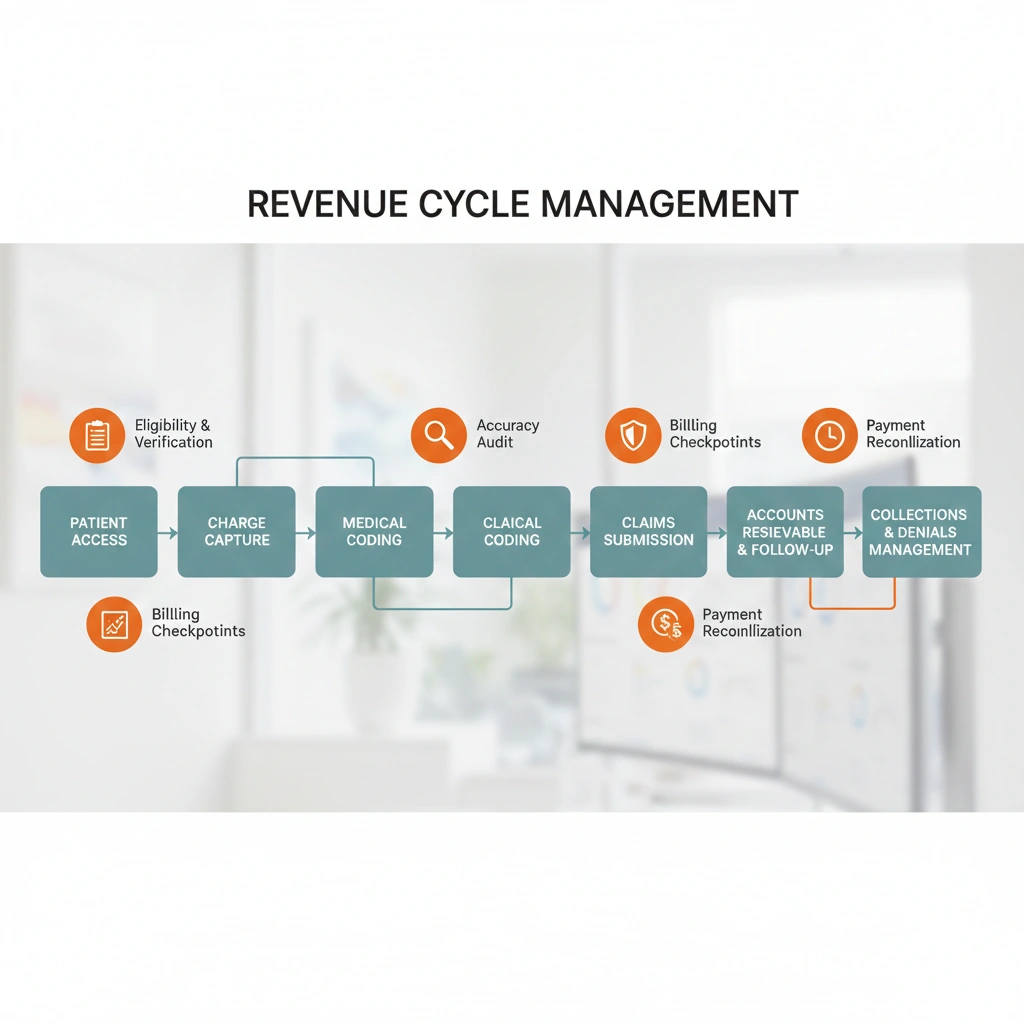
How Medical Billing Impacts Each Stage of the Revenue Cycle
1. Patient Registration & Eligibility Verification
Billing accuracy begins before treatment starts. Incorrect patient or insurance data causes downstream claim rejections.
Efficient billing teams:
- Verify insurance eligibility
- Confirm coverage details
- Capture accurate demographics
This improves Medical Billing Revenue Cycle Performance by preventing avoidable errors.
2. Medical Coding Accuracy
Coding translates clinical services into billable codes.
Errors in:
- CPT codes
- ICD-10 diagnosis codes
- HCPCS modifiers
directly harm Medical Billing Revenue Cycle Performance by triggering denials or underpayments.
Accurate coding ensures providers receive full, compliant reimbursement.
3. Clean Claim Submission
Clean claims are complete, error-free, and submitted correctly the first time.
High clean-claim rates result in:
- Faster payments
- Fewer resubmissions
- Lower administrative costs
This step alone can significantly boost Medical Billing Revenue Cycle Performance.
4. Denial Management and Appeals
Denials are inevitable—but unmanaged denials damage cash flow.
Effective billing teams:
- Analyze denial patterns
- Correct root causes
- Appeal claims promptly
Strong denial management protects Medical Billing Revenue Cycle Performance by recovering lost revenue.
5. Payment Posting and Reconciliation
Accurate payment posting ensures:
- Correct insurer payments
- Proper patient balances
- Identification of underpayments
Errors here distort financial reporting and weaken revenue cycle efficiency.
6. Patient Billing and Collections
Clear, transparent patient billing improves collections.
Efficient billing systems:
- Reduce billing confusion
- Improve patient trust
- Shorten payment cycles
This directly strengthens Medical Billing Revenue Cycle Performance by reducing outstanding balances.
Common Billing Issues That Hurt Revenue Cycle Performance
Healthcare practices often struggle with:
- Inaccurate coding
- Incomplete documentation
- Late claim submissions
- Poor denial follow-up
- Inefficient billing software
Each issue weakens Medical Billing Revenue Cycle Performance and creates financial instability.
How Technology Improves Medical Billing Revenue Cycle Performance
Modern billing technology enhances performance through:
- Automated eligibility checks
- Real-time coding validation
- AI-driven denial prediction
- Analytics for revenue insights
Technology reduces manual errors and improves Medical Billing Revenue Cycle Performance across all departments.
Benefits of Optimized Medical Billing for Healthcare Providers
When billing is optimized, providers experience:
- Faster reimbursements
- Reduced claim denials
- Improved cash flow
- Lower administrative burden
- Better compliance
All these benefits are indicators of strong Medical Billing Revenue Cycle Performance.
Why Many Providers Outsource Medical Billing
Outsourcing billing allows providers to:
- Access specialized expertise
- Reduce operational costs
- Improve billing accuracy
- Focus on patient care
Professional billing companies often outperform in-house teams, delivering better Medical Billing Revenue Cycle Performance.

Key Metrics That Measure Medical Billing Revenue Cycle Performance
Healthcare organizations track:
- Clean claim rate
- Days in accounts receivable
- Denial rate
- Net collection rate
- Cost to collect
Monitoring these metrics ensures continuous improvement in Medical Billing Revenue Cycle Performance.
Compliance and Its Role in Revenue Cycle Success
Compliance failures result in:
- Claim rejections
- Audits
- Penalties
HIPAA-compliant billing protects data and ensures uninterrupted Medical Billing Revenue Cycle Performance.
Future Trends in Medical Billing and Revenue Cycle Performance
Emerging trends include:
- AI-driven coding
- Predictive denial management
- Automated patient billing
- Advanced analytics
These innovations will further enhance Medical Billing Revenue Cycle Performance in the coming years.

Frequently Asked Questions
1. What is Medical Billing Revenue Cycle Performance?
It measures how efficiently healthcare billing processes convert services into revenue.
2. How does billing accuracy affect revenue cycle performance?
Accurate billing reduces denials and speeds up reimbursements.
3. Can outsourcing improve revenue cycle performance?
Yes. Specialized billing companies often deliver better accuracy and faster payments.
4. What is the biggest threat to revenue cycle performance?
Coding errors and poor denial management.
Medical billing is not just an administrative task—it is the engine that drives financial health. Optimizing Medical Billing Revenue Cycle Performance ensures sustainable growth, operational efficiency, and improved patient trust.
Healthcare providers who invest in accurate billing processes, advanced technology, and professional expertise are best positioned for long-term success.
Author: Mangesh
Last Updated: December 2025
Category: Medical Billing & Revenue Cycle Management
Follow Us: facebook.com | instagram.com | linkedin.com | BackBoneDataSolutions.com